
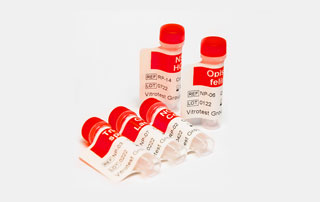
Chlamydia trachomatis recombinant antigen MOMP
| CAT. # | RP-03 |
| Product description | The recombinant protein is an analogue of Major Outer Membrane protein (MOMP) of Chlamydia trachomatis, expressed and derived from E.coli |
| Purification methods | Purified by affinity chromatography |
| Buffer composition | 50mM Tris, 300mM NaCl, 8M Urea, 250 mM imidazole, pH8.0 |
| Preservative | None |
| Storage | Frozen at -70 ˚C, avoid repeated freeze-thaw cycles |
Chlamydia trachomatis recombinant antigen MOMP
| CAT. # | RP-03 |
| Product description | The recombinant protein is an analogue of Major Outer Membrane protein (MOMP) of Chlamydia trachomatis, expressed and derived from E.coli |
| Purification methods | Purified by affinity chromatography |
| Buffer composition | 50mM Tris, 300mM NaCl, 8M Urea, 250 mM imidazole, pH8.0 |
| Preservative | None |
| Storage | Frozen at -70 ˚C, avoid repeated freeze-thaw cycles |