
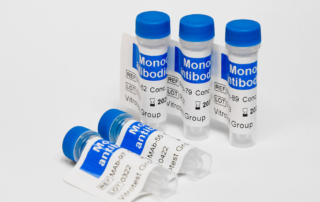
Anti-human IgE monoclonal antibodies E1
| CAT. # | MAb-13 |
| Product description | Murine monoclonal antibodies specific to human IgE (for coating) |
| Isotype | IgG1 |
| Clone | E1 |
| Buffer composition | PBS, pH 7.2-7.4 |
| Preservative | BND |
| Storage | 6 months at 2-8 ˚C , 24 months at -20±5 ˚C with 50 % glycerol |
Anti-human IgE monoclonal antibodies E3
| CAT. # | MAb-14 |
| Product description | Murine monoclonal antibodies specific to human IgE (for coating) |
| Isotype | IgA |
| Clone | E3 |
| Buffer composition | PBS, pH 7.2-7.4 |
| Preservative | BND |
| Storage | 6 months at 2-8 ˚C , 24 months at -20±5 ˚C with 50 % glycerol |
Anti-human IgE monoclonal antibodies E4
| CAT. # | MAb-15 |
| Product description | Murine monoclonal antibodies specific to human IgE (for coating) |
| Isotype | IgG2b |
| Clone | E4 |
| Buffer composition | PBS, pH 7.2-7.4 |
| Preservative | BND |
| Storage | 6 months at 2-8 ˚C , 24 months at -20±5 ˚C with 50 % glycerol |
Anti-human IgE monoclonal antibodies E5
| CAT. # | MAb-16 |
| Product description | Murine monoclonal antibodies specific to human IgE |
| Isotype | IgG2b |
| Clone | E5 |
| Buffer composition | PBS, pH 7.2-7.4 |
| Preservative | BND |
| Storage | 6 months at 2-8 ˚C , 24 months at -20±5 ˚C with 50 % glycerol |
Anti-human IgE monoclonal antibodies E1
| CAT. # | MAb-13 |
| Product description | Murine monoclonal antibodies specific to human IgE (for coating) |
| Isotype | IgG1 |
| Clone | E1 |
| Buffer composition | PBS, pH 7.2-7.4 |
| Preservative | BND |
| Storage | 6 months at 2-8 ˚C , 24 months at -20±5 ˚C with 50 % glycerol |
Anti-human IgE monoclonal antibodies E3
| CAT. # | MAb-14 |
| Product description | Murine monoclonal antibodies specific to human IgE (for coating) |
| Isotype | IgA |
| Clone | E3 |
| Buffer composition | PBS, pH 7.2-7.4 |
| Preservative | BND |
| Storage | 6 months at 2-8 ˚C , 24 months at -20±5 ˚C with 50 % glycerol |
Anti-human IgE monoclonal antibodies E4
| CAT. # | MAb-15 |
| Product description | Murine monoclonal antibodies specific to human IgE (for coating) |
| Isotype | IgG2b |
| Clone | E4 |
| Buffer composition | PBS, pH 7.2-7.4 |
| Preservative | BND |
| Storage | 6 months at 2-8 ˚C , 24 months at -20±5 ˚C with 50 % glycerol |
Anti-human IgE monoclonal antibodies E5
| CAT. # | MAb-16 |
| Product description | Murine monoclonal antibodies specific to human IgE |
| Isotype | IgG2b |
| Clone | E5 |
| Buffer composition | PBS, pH 7.2-7.4 |
| Preservative | BND |
| Storage | 6 months at 2-8 ˚C , 24 months at -20±5 ˚C with 50 % glycerol |